
For decades, the conversation around barefoot movement has been dominated by one question:
Should we run barefoot?
While that debate sparked tremendous interest in foot function, it also limited our understanding of what barefoot science is truly about. Today, the conversation has evolved far beyond footwear. We now recognize that the foot is not simply a structure that supports the body—it is a sophisticated sensory organ that plays a critical role in balance, movement efficiency, brain health, and longevity.
As both a functional podiatrist and movement specialist, I've spent my career helping people understand that healthy feet are not defined by the shoes they wear. They are defined by how well they move, perceive the ground beneath them, and communicate with the rest of the body.
The latest research continues to reinforce this perspective.
Barefoot Is About Sensation, Not Just Shoes
One of the biggest misconceptions is that barefoot science is about eliminating footwear.
It isn't.
The real goal is improving foot function.
Walking barefoot—or wearing footwear that allows the foot to move and perceive the ground more naturally—can increase sensory input from the thousands of mechanoreceptors located on the sole of the foot. These receptors constantly provide the brain with information about balance, body position, and movement.
The better your brain perceives the ground, the more efficiently it can organize movement.
That's why I often say: Movement begins with perception.
Better Balance Starts at the Feet
One of the earliest findings that excited me showed improvements in postural control when individuals transitioned from traditional athletic shoes to minimalist footwear or barefoot training.
Rather than reducing stability, exposing the foot to more sensory information actually improved medial-lateral balance control.
Over the past decade, additional research has strengthened this concept. Studies continue to demonstrate that improving plantar sensory feedback can enhance postural control, gait performance, and balance—particularly in older adults and individuals with reduced plantar sensation. These findings support the growing role of sensory stimulation as part of fall prevention and movement rehabilitation.
This isn't simply about stronger muscles.
It's about a smarter nervous system.
The Great Toe Is the MVP
When we think about strengthening the foot, many people immediately think about curling the toes.
But not all toe muscles are created equal.
The flexor hallucis brevis, which controls the great toe, produces substantially more force than the smaller toe flexors. From walking to sprinting, the great toe is responsible for creating a stable propulsive platform during push-off.
This is one reason I emphasize the Short Foot Exercise so heavily in both rehabilitation and performance training.
Short Foot isn't about scrunching your toes.
It's about activating the intrinsic muscles that support the arch while maintaining a long, stable great toe.
When performed correctly, it creates a stronger foundation for the entire lower extremity.
Strength Training Should Mimic Walking
One of my favorite concepts from the literature is that we should train the foot the same way we use it.
Research demonstrates that toe flexor strength is optimized when training occurs in the position where the foot naturally produces force:
- ankle in slight plantarflexion
- metatarsophalangeal joints extended
- loading through the forefoot
In other words...
Train the foot like it's walking.
Not like it's picking up marbles.
Since those early studies, newer research has expanded on this concept by showing that progressive forefoot strengthening—including high-force isometrics and plyometric exercises—can significantly improve intrinsic foot strength, forefoot power, and athletic performance. This represents an important evolution from isolated toe exercises toward functional, sport-specific loading.
Barefoot Doesn't Mean Everyone Should Squat Barefoot
Another important lesson from the research is that simply removing shoes doesn't automatically improve movement.
In fact, for individuals with limited ankle mobility, switching to barefoot squatting can actually expose compensations.
When adequate ankle dorsiflexion is lacking, people often compensate by excessively leaning the trunk forward or altering hip mechanics.
This doesn't mean barefoot squatting is wrong.
It simply means mobility must support the movement.
Barefoot training should reveal dysfunction—not create it.
Your Feet Influence Your Brain
Perhaps one of the most fascinating developments in barefoot science is the growing appreciation for the connection between the feet and the brain.
Early research suggested that stimulating the feet increased activity in areas of the brain responsible for attention and sensory processing.
Today, advances in neuroscience continue to support the concept that the feet are a powerful source of sensory information for the central nervous system.
We're seeing increasing evidence that plantar sensory stimulation influences:
- balance
- gait variability
- motor learning
- postural control
- cognitive-motor performance
This is particularly exciting as we explore interventions for healthy aging, neurological rehabilitation, and movement longevity.
The foot isn't just helping you stand.
It's helping your brain understand where your body is in space.
Don't Guess—Measure
One of the most overlooked aspects of foot assessment is relying solely on visual observation.
I continue to recommend objectively measuring navicular drop rather than simply looking at arch height.
A difference greater than approximately 10 mm between non-weight-bearing and weight-bearing positions suggests excessive midfoot mobility and warrants further evaluation.
Objective measurements allow us to monitor progress and individualize treatment rather than relying on subjective impressions.
Foot Strength Requires Volume
Just like any other muscle group, the intrinsic foot muscles require adequate training volume to adapt.
Early research highlighted the importance of higher repetitions and sustained contractions for improving endurance and motor control.
In practice, this means consistency matters more than intensity.
A few repetitions performed occasionally are unlikely to produce meaningful changes.
Daily practice creates lasting adaptation.
The Paper Grip Test
One of my favorite clinical tools remains remarkably simple.
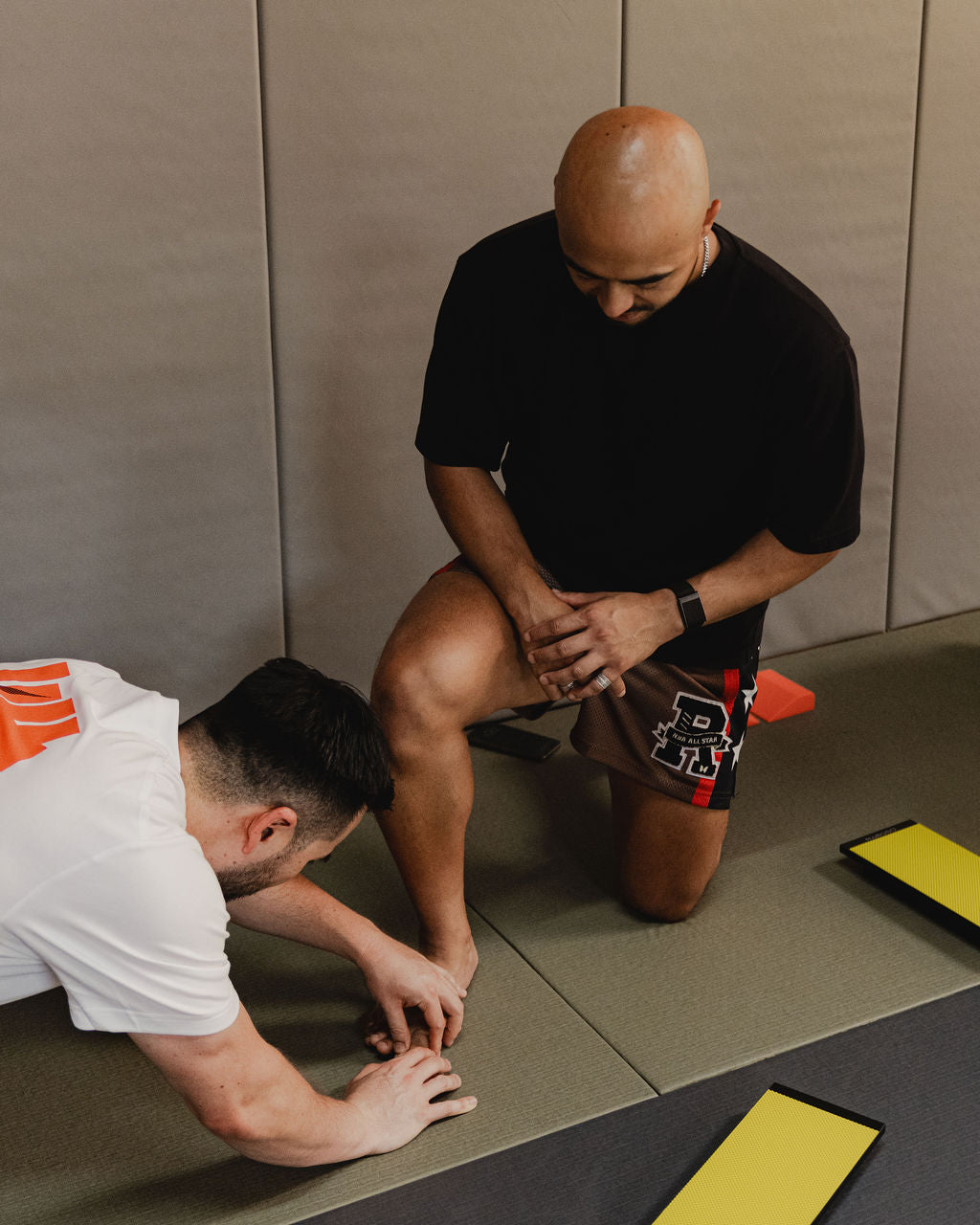
Place a small piece of paper beneath the great toe and ask the patient to hold it without curling the toe.
If the paper pulls away easily, there's often an opportunity to improve intrinsic foot activation.
This simple assessment provides immediate feedback and helps patients understand how to activate the arch correctly during Short Foot training.
Sometimes the best clinical tools don't require expensive technology.
They require thoughtful observation.
The Future of Barefoot Science
Over the last decade, barefoot science has matured tremendously.
We've moved beyond asking whether shoes are good or bad.
Instead, we're asking better questions:
- How does sensory input influence movement?
- How do we improve foot strength?
- How do we enhance balance through the nervous system?
- How can foot function support healthy aging?
- How do we build resilient feet capable of lifelong movement?
These are the questions that define the future of movement science.
As our understanding continues to evolve, one principle remains unchanged: Healthy movement begins with healthy feet.
Not because the feet are the most important part of the body.
But because they are the body's first point of contact with the world.
Every step begins there.
Every movement begins there.
And every opportunity to improve movement longevity starts by helping the brain better perceive the ground beneath us.
Dr. Emily's Takeaway
The biggest shift in barefoot science over the past decade hasn't been about footwear—it has been about understanding the foot as a sensory organ. Strong feet matter, but strong feet that provide rich, accurate information to the brain matter even more. That's why my work has evolved from simply teaching barefoot movement to advancing Sensory Intelligence™—the idea that better sensation leads to better movement, better movement supports healthier tissues, and healthier movement is one of the foundations of longevity. The future isn't barefoot versus shoes. The future is learning how to optimize the conversation between your feet and your brain.


Leave a comment
This site is protected by hCaptcha and the hCaptcha Privacy Policy and Terms of Service apply.