

Watching a contortionist move can change how you think about flexibility. Their performance involves entering extraordinary positions, holding them, and transitioning between them with precision.
That distinction brings us to an important part of hypermobility care. How far a joint moves and how well someone controls that movement are different qualities. Understanding both helps explain why some flexible people move comfortably while others experience pain, instability, or difficulty sensing their joint position.
Understanding Generalized vs Clinical Hypermobility
Joint hypermobility describes movement beyond the range typically expected for a particular joint. When it occurs across multiple areas of the body, it is called generalized hypermobility. Some people have this trait without associated symptoms. Others experience problems that require clinical assessment.
Clinical hypermobility is often used informally to describe hypermobility associated with symptoms, such as persistent pain, recurrent sprains, or joints that feel unstable. A clinician evaluates those symptoms, the person’s history, and other physical findings to determine the appropriate diagnosis.
Two diagnoses that may arise from that assessment are:
- Hypermobility spectrum disorder (HSD). Symptomatic joint hypermobility that is not explained by another condition. It can affect joints throughout the body or be more localized.
- Hypermobile Ehlers-Danlos syndrome (hEDS). A heritable connective tissue disorder diagnosed using specific clinical criteria, including generalized joint hypermobility, additional features, and exclusion of other explanations.
The distinction matters because joint range alone tells us little about someone’s symptoms or support needs. A person with HSD can have substantial difficulties with everyday movement and deserves care suited to those difficulties.
What We Can Learn from Contortionists
Contortion provides a useful example of the difference between available range and actively controlled range. A performer may be able to enter a position with assistance, yet need considerable strength and practice to hold it or move out of it smoothly.
The practical lesson is to pay attention to how someone enters, supports, and exits a movement. Circus rehabilitation literature emphasizes strength, movement retraining, and learning when to use a smaller or fuller range. Research specific to contortionists remains limited, so these lessons are best understood as principles of movement practice rather than proof of a particular treatment outcome.
For someone managing symptomatic hypermobility, this translates into questions such as:
- Can I enter this position slowly?
- Can I hold it without feeling that the joint is giving way?
- Can I return with control?
- How does my body feel afterward?
The useful takeaway from contortion is the attention to control. Everyday activities may require that control within a much smaller, individually appropriate range.
The Two Layers of Joint Stability
Joint stability depends on mechanical support and neuromuscular control working together.
Mechanical stability comes from structures such as ligaments and joint capsules, which help support and guide a joint. Neuromuscular control involves the nervous system coordinating muscle activity as the body moves.
When connective tissues provide less restraint, muscle support and movement coordination become important parts of managing the joint. In hEDS and HSD, clinicians may also consider altered muscle tone, proprioception, and previous injuries when assessing instability.
Why Proprioception Matters
Proprioception is your sense of body position and movement. It helps you recognize where your ankle is as you step, how your knee is positioned during a squat, and how far your shoulder has moved.
Some people with symptomatic hypermobility experience reduced proprioceptive accuracy. They may find it harder to recognize a joint position or repeat a movement consistently. The reasons are complex, and research continues to examine how sensory processing and muscle control contribute.
This is where deliberate practice becomes valuable. A cue from a therapist, feedback from a mirror, or attention to pressure beneath the feet can give someone a clearer point of reference while learning a movement.
Bring the Feet into the Conversation
The soles of the feet receive tactile information during contact with the ground. Paying attention to that contact offers a practical way to explore pressure, weight shifts, and movement.
A study of 65 asymptomatic young adults with generalized joint hypermobility found that a two-week program combining foot sensory activities and exercises improved several sensory measures, ankle position accuracy, and one direction of a dynamic balance test. These findings support further investigation of foot sensory training as part of a broader movement program.
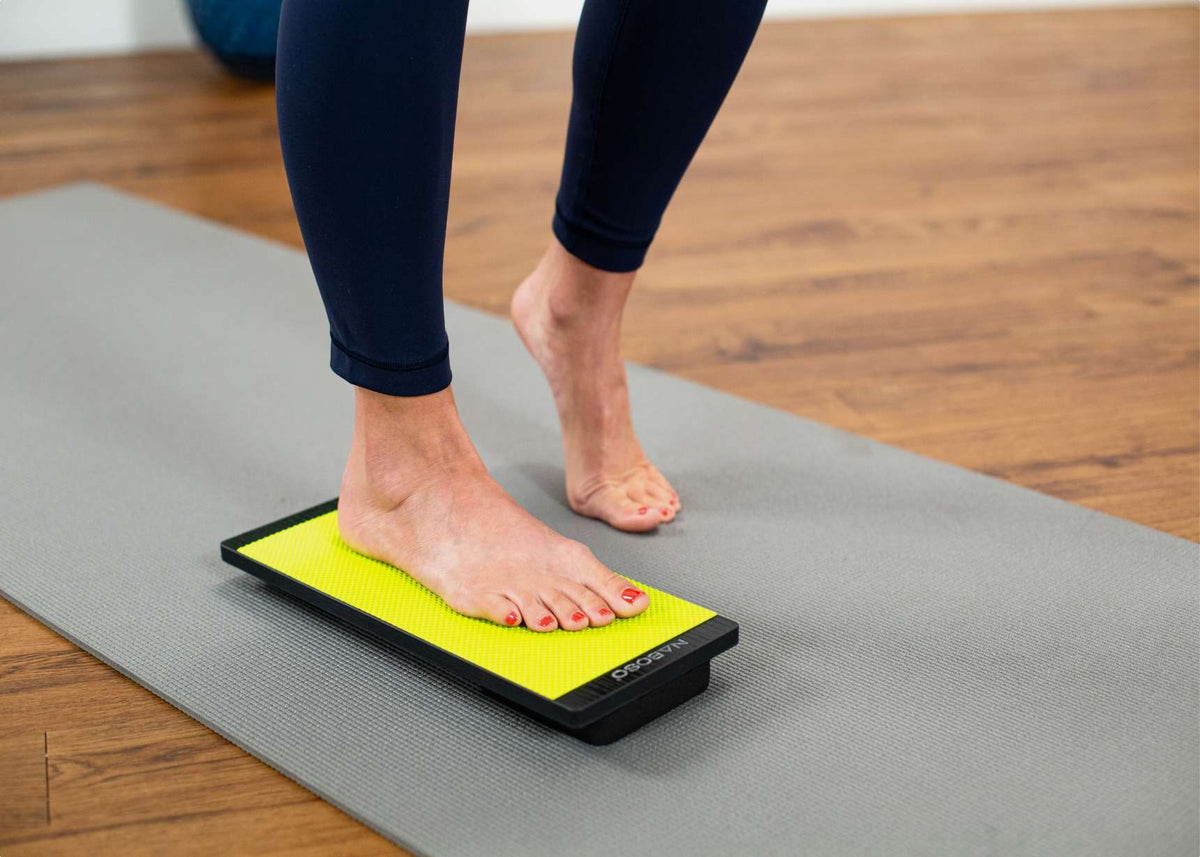
Naboso textured insoles provide a tactile surface beneath the feet. During guided movement practice, that surface can become something to notice. Where do you feel contact? How does it change as you shift your weight? Can you reproduce the movement slowly?
Other sensory approaches include supportive taping and clinician-directed vibration. Their use should reflect the individual’s symptoms, skin tolerance, and response. Evidence for sensory products in hypermobility is preliminary, including a small pilot study of sensory insoles and compression garments in hEDS. That study does not establish outcomes for Naboso products.
Build Strength Alongside Awareness
Sensory awareness and strength address complementary parts of movement. A person needs to recognize a position and have the capacity to support it.
Research on rehabilitation in HSD and hEDS supports therapeutic exercise and motor control training. A personalized program can develop strength, coordination, and confidence while accounting for pain, fatigue, and joint stability.
A physical therapist familiar with hypermobility can help identify an appropriate starting point. That may involve supported balance practice, controlled strengthening, or work on walking mechanics. Begin with manageable demands and progress according to your response.
Contortionists draw our attention to extraordinary movement. The principle we can bring into daily life is more accessible. Practice feeling where you are, supporting that position, and moving through it with control.


Leave a comment
This site is protected by hCaptcha and the hCaptcha Privacy Policy and Terms of Service apply.