
When we think about optimizing movement, we often focus on building stronger muscles, increasing flexibility, or improving joint mobility. But what if the missing link to better movement isn't simply mechanical? What if it's sensory?
The ankle joint complex is one of the most important regions of the body when it comes to movement efficiency, balance, and athletic performance. With every step we take, our ankles must absorb force, adapt to the ground, stabilize our body, and ultimately generate the power needed to propel us forward.
Yet, despite these incredible demands, ankle function is often reduced to a conversation about calf strength or dorsiflexion.
I want to challenge that perspective.
Optimal ankle function requires the integration of three essential components: stability, mobility, and power. And connecting all three is the nervous system.
Let's explore how a neurosensory approach can transform the way we assess, train, and optimize the ankle joint complex.
1. Ankle Stability: It's More Than Just Strength
When we talk about ankle stability, most people immediately think about strengthening the muscles surrounding the ankle.
While strength is important, true stability begins with sensory awareness.
The nervous system must continuously receive and interpret information about joint position, movement, and the forces interacting with the body.
Two important sensory concepts I emphasize are proprioception and mechanoception.
Proprioception is our ability to sense joint position and movement without relying on vision. It allows us to know where our ankle is in space and make the rapid adjustments needed to maintain balance.
Mechanoception refers to our ability to detect mechanical stimuli, including vibration, texture and other forms of mechanical deformation.
These sensory inputs contribute to the nervous system's ability to organize muscular responses and maintain dynamic joint stability.
Think about walking across uneven terrain. Your ankle is constantly making small adjustments in response to the ground beneath you. These adjustments occur rapidly, often before you are consciously aware of them.
This is where sensory training becomes so powerful.
Training Stability Through Micro-Perturbations
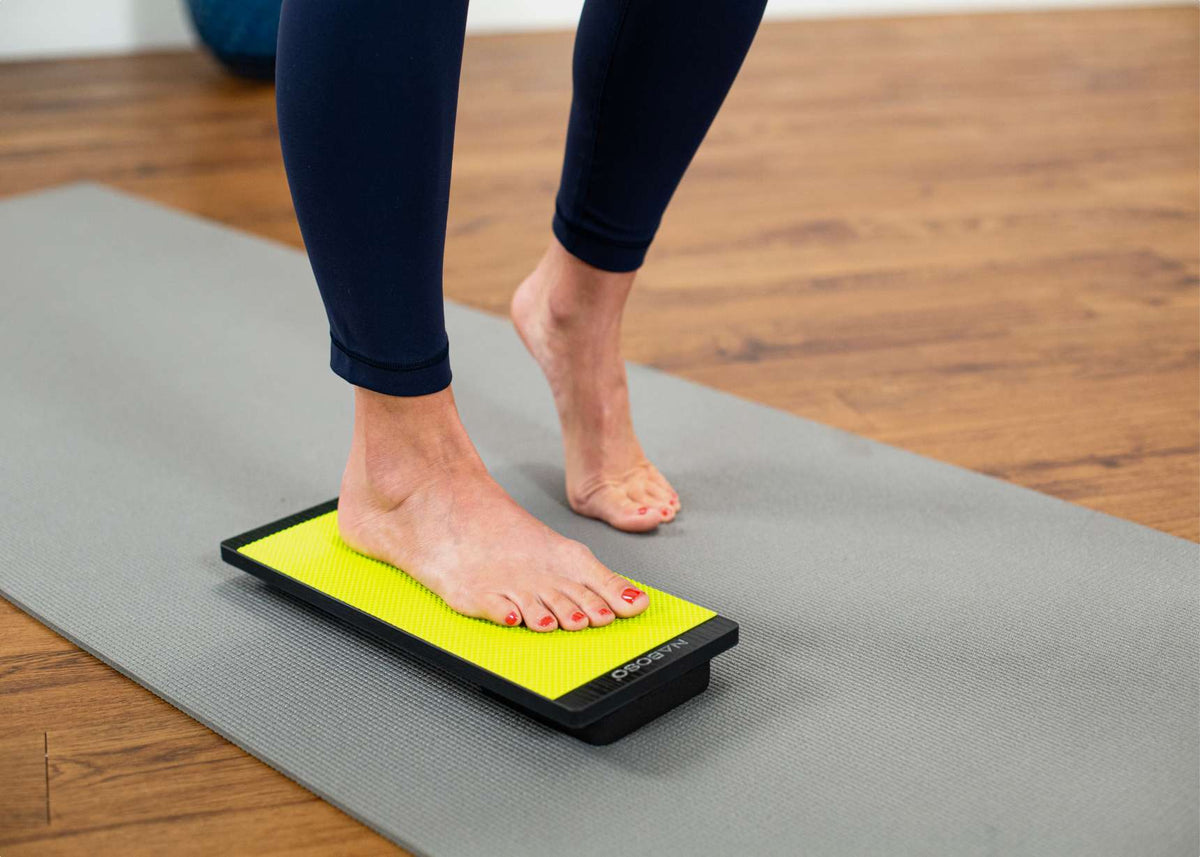
One of my favorite ways to challenge ankle stability is through micro-perturbation training using the Naboso Kinesis Board.
Unlike traditional balance exercises that focus primarily on maintaining a static position, micro-perturbations introduce subtle, continuous changes in joint position and loading.
These small disturbances challenge the sensory and motor systems to communicate and respond.
The goal isn't simply to stand on an unstable surface.
It's to improve the nervous system's ability to detect movement, organize a response, and maintain control.
The takeaway: Stability is not the absence of movement. Stability is the ability to control movement.
2. Ankle Mobility: Why Sagittal Plane Motion Matters
Once we establish stability, the next piece of the puzzle is mobility.
The ankle joint complex must move efficiently through the sagittal plane, particularly during dorsiflexion and plantarflexion.
During walking, dorsiflexion allows the tibia to advance over the foot as the body moves forward.
When this motion is restricted, the body doesn't simply stop moving.
It compensates.
And these compensations can influence movement mechanics throughout the entire lower extremity.
Common Signs of Restricted Ankle Mobility
Two movement patterns I encourage professionals to look for are:
An out-toed gait pattern. When an individual walks with the feet excessively turned outward, one possible contributor is limited ankle dorsiflexion. By changing the orientation of the foot, the body may find an alternative strategy to move forward.
A pronatory snap. This describes a rapid movement into pronation during gait that may occur as the foot attempts to accommodate restricted ankle mechanics.
These patterns are not diagnoses on their own, but they are important clues.
Rather than immediately trying to correct the position of the foot, I encourage practitioners to ask a more important question:
Why is the body choosing this movement strategy?
Sometimes the answer lies in the ankle's ability to access and control the mobility needed for efficient gait.
The Talus: A Critical Piece of Ankle Mechanics
At the center of ankle mobility is the talus.
The talus plays an essential role in the mechanical relationship between the tibia, fibula, and foot.
Efficient dorsiflexion requires coordinated movement at the talocrural joint, including the appropriate arthrokinematics of the talus.
When ankle mobility is restricted, we need to consider not only muscular flexibility but also joint mechanics and the surrounding soft tissues.
This is why I integrate both soft tissue techniques and targeted joint mobilization into my approach.
3. Restoring Mobility: Soft Tissue Release and Joint Mobilization
Before asking the ankle to move through a greater range of motion, I like to consider the quality of the tissues and the sensory information entering the system.
The foot is our primary interface with the ground, and the plantar tissues contain sensory receptors that contribute to our perception of pressure, movement, and loading.
One of the tools I use to introduce targeted stimulation to the plantar foot is the Naboso Neuro Ball.
Through controlled rolling and pressure, we can stimulate the plantar tissues while encouraging greater awareness of the foot.
I often integrate this type of sensory stimulation before mobility exercises to prepare the foot and ankle for movement.
From there, we can incorporate band-assisted ankle mobilizations designed to encourage more efficient talocrural joint mechanics.
The intention is to improve the available motion of the ankle while maintaining appropriate joint alignment and control.
But here's an important distinction:
Creating more range of motion is only part of the goal. We must also teach the nervous system how to control and use that new range.
Mobility without control does not necessarily translate into better movement.
This is why I believe that sensory stimulation, mobility work, and active movement should be integrated rather than treated as separate interventions.
4. Ankle Power: Turning Mobility Into Propulsion
The final component of optimal ankle function is power.
Once the ankle can stabilize and move efficiently, it must be able to generate and transmit force.
During gait, plantarflexion contributes to the push-off phase, helping propel the body forward.
This requires coordination among the calf musculature, foot muscles, and the larger kinetic chain.
However, I don't want you to think about ankle power as an isolated calf-strengthening exercise.
Power is the result of coordinated force production and transmission through the entire body.
The foot, ankle, and core must work together to create efficient movement.
Connecting the Foot to the Core
One exercise I highlight in the webinar is the ball between the heels exercise.
This exercise is used to encourage integrated activation through the lower extremity while connecting foot and ankle mechanics with proximal muscular control.
Rather than thinking only about pushing through the toes or contracting the calf muscles, we want to create awareness of how the entire system contributes to plantarflexion and propulsion.
This becomes particularly relevant during walking, running, jumping, and other athletic movements where force must be transferred efficiently through the foot and ankle.
For me, this is where ankle training becomes much more interesting.
We're no longer training an isolated joint.
We're training an integrated movement system.
5. Bringing It All Together: The Sensory Approach to Ankle Function
When I assess an individual with ankle dysfunction, I don't want to look only at whether the ankle is strong or flexible.
I want to understand how the entire system is functioning.
Can the individual sense where the ankle is positioned?
Can they respond to subtle changes in loading?
Do they have sufficient dorsiflexion for efficient gait?
Can they control that mobility?
And finally, can they generate and transfer force when it's time to move?
These questions form the foundation of my approach to optimizing ankle function.
Stability. Mobility. Power.
Each component is important, but none operates independently.
Stability creates the foundation for controlled movement. Mobility allows the body to access the ranges required for efficient mechanics. Power transforms that movement capacity into propulsion.
And sensory information helps coordinate the entire process.
6. Beyond the Ankle: Common Questions About Footwear, Tendons, and Recovery
During the webinar, we also explored several common questions that come up in clinical practice and movement training.
What about chronic tendon strains?
Chronic tendon problems require us to look beyond the site of discomfort.
We need to consider tissue-loading history, joint mechanics, strength, and how force is distributed throughout the lower extremity.
Rather than focusing exclusively on the painful tissue, I encourage a broader assessment of the movement system.
Are rocker-bottom shoes, such as Hoka, beneficial?
Rocker-bottom footwear can change how the foot and ankle move during gait.
For certain individuals, this may help reduce the demand for ankle motion or modify loading during walking.
However, I distinguish between using footwear to accommodate a movement limitation and actively improving the body's movement capacity.
The best choice depends on the individual's goals, symptoms, and functional needs.
Percussion versus vibration: What's the difference?
Although both deliver mechanical stimulation, percussion and vibration are not identical.
Percussive devices deliver repeated mechanical impacts, while vibration delivers oscillatory mechanical stimulation.
The frequency, amplitude, and method of application influence the stimulus delivered to the tissues and sensory system.
Understanding these differences allows us to be more intentional about how we incorporate sensory and mechanical stimulation into movement preparation and recovery.
Final Thoughts: Better Movement Begins With Better Sensory Awareness
The ankle is so much more than a joint that moves up and down.
It is a dynamic interface between the ground and the rest of the body.
Every step requires an ongoing conversation between sensory receptors, the nervous system, muscles, and connective tissues.
When we approach ankle health through this integrated perspective, we begin to appreciate that optimizing movement isn't simply about increasing strength or flexibility.
It's about improving the quality of information entering the nervous system and the body's ability to respond to that information.
Whether you're working with an athlete looking to improve performance, an individual recovering from an ankle injury, or someone seeking better balance and movement longevity, I encourage you to think beyond isolated ankle exercises.
Train the sensory system. Restore the mobility. Build the stability. Unlock the power.
Because the ultimate goal isn't simply to move more.
It's to move better, with greater awareness, efficiency, and resilience.


Leave a comment
This site is protected by hCaptcha and the hCaptcha Privacy Policy and Terms of Service apply.