
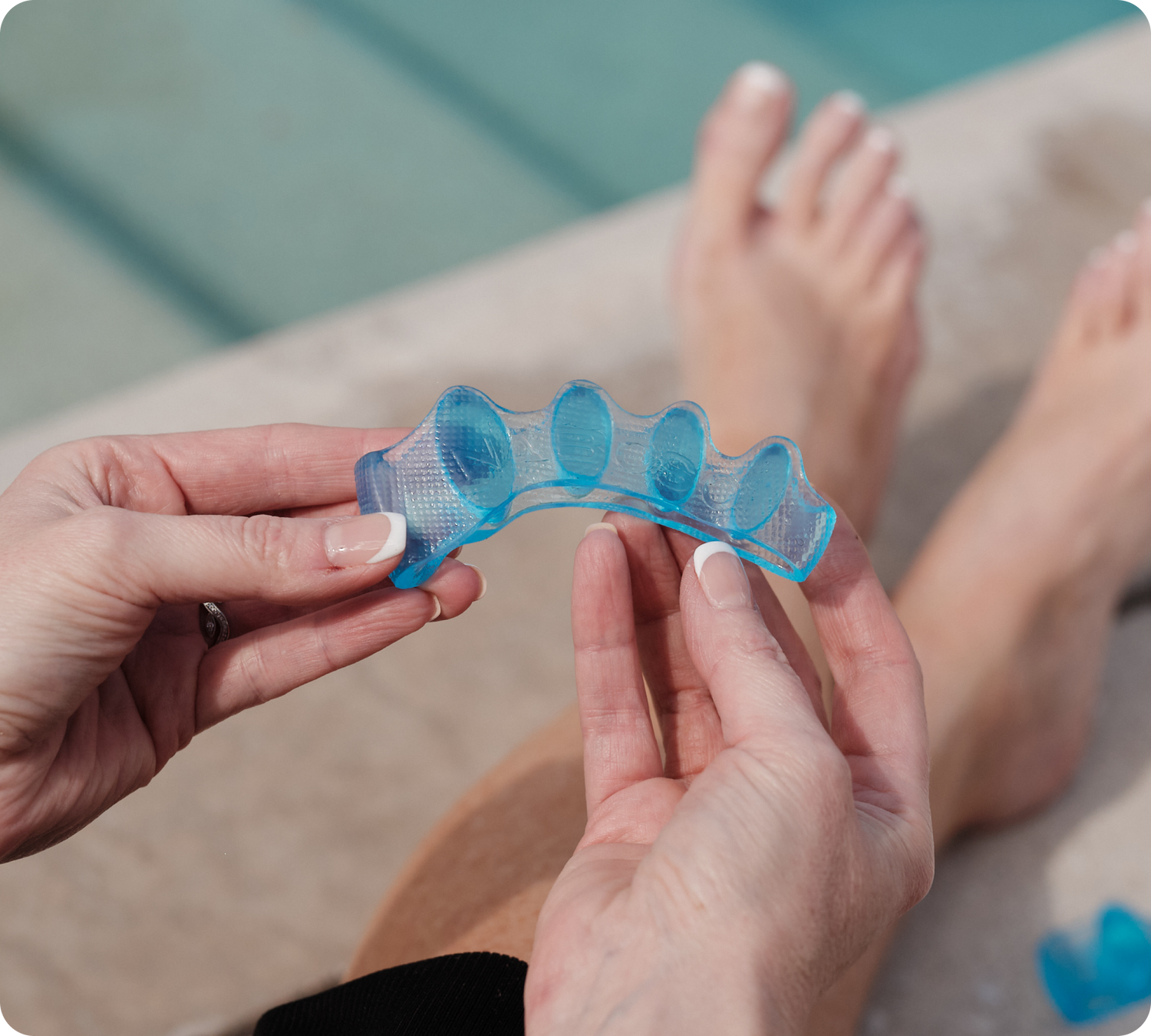
Toe spacers are often thought of as a niche product used only for bunions or cosmetic toe alignment. But the reality is far more powerful.
Your toes play a critical role in balance, stability, walking efficiency, foot strength, and full-body movement. When the toes lose their natural alignment - often from years of narrow footwear, compression, and lack of barefoot movement - the entire body begins to compensate.
Toe spacers are not simply about straightening toes.
They are about restoring the natural foundation of human movement
Why Your Toes Matter More Than You Think
Most people underestimate the role the toes play in movement.
Your toes help:
- stabilize the body against the ground
- create balance and postural control
- absorb and transfer force during walking
- activate the intrinsic foot muscles
- support gait efficiency and propulsion
The big toe alone is responsible for a significant portion of push-off power during walking and running.
When the toes become compressed, weak, or misaligned:
- balance decreases
- foot strength declines
- gait mechanics change
- stability suffers
- compensation patterns travel up the kinetic chain
This is one reason why foot dysfunction is often connected to:
- knee pain
- hip instability
- low back tension
- plantar fasciitis
- reduced athletic performance
How Modern Shoes Change Foot Function
Most modern shoes squeeze the toes together.
Narrow toe boxes limit natural toe splay, reducing the foot’s ability to sense the ground, stabilize efficiently, and activate the small muscles that support posture and movement.
Over time this can contribute to:
- weakened intrinsic foot muscles
- reduced balance
- bunion formation
- hammer toes
- nerve irritation
- altered gait mechanics
Toe spacers help reverse this by restoring space between the toes and allowing the foot to function more naturally.
How Toe Spacers Improve Balance & Stability
The toes are packed with sensory receptors that help your brain understand where your body is in space.
This sensory input influences:
- balance
- coordination
- postural control
- walking confidence
- dynamic stability
When the toes are compressed or lose contact with the ground, the nervous system receives less accurate information.
Toe spacers improve toe contact and toe alignment, helping:
- increase sensory awareness
- improve balance
- enhance foot stability
- restore more natural gait mechanics
This is especially important as we age, since reduced toe strength and sensory input are associated with increased fall risk and movement decline.
The Connection Between Toe Alignment & Full-Body Movement
Your feet are the foundation of the kinetic chain.
Even small changes in toe alignment can influence:
- ankle mobility
- arch mechanics
- glute activation
- pelvic control
- rotational movement patterns
For example, restricted motion of the big toe joint can reduce hip extension during walking and alter how force transfers through the body.
This is why toe dysfunction is rarely “just a foot problem.”
The body compensates upward.
Toe Spacers for Bunions
A bunion develops when the big toe gradually drifts away from its natural alignment, creating instability at the first metatarsophalangeal (MTP) joint.
This can lead to:
- joint compression
- cartilage stress
- stiffness
- inflammation
- reduced propulsion during gait
Toe spacers help by:
- encouraging better toe alignment
- reducing compression at the joint
- improving toe splay
- restoring foot function and stability
While toe spacers may not reverse advanced bunions, they can help slow progression, improve comfort, and support healthier movement mechanics.
Toe Spacers for Hammer Toes
Hammer toes occur when the toes become stuck in a bent position due to muscle imbalance, compensation patterns, or long-term footwear compression.
Some hammer toes remain flexible, while others become rigid over time.
Toe spacers may help:
- improve toe positioning
- reduce crowding and pressure
- restore muscular balance
- improve comfort and foot function
Even when structural correction is limited, improving alignment and reducing compression can significantly improve movement quality.
Toe Spacers for Neuromas
Neuromas are often caused by compression and irritation of nerves between the metatarsal heads.
Symptoms may include:
- burning
- tingling
- numbness
- sharp forefoot pain
Toe spacers help by:
- spreading the metatarsals
- reducing nerve compression
- improving circulation
- decreasing pressure in the forefoot
When combined with proper footwear and metatarsal support, toe spacers can be a powerful conservative tool for neuroma management.
The Link Between Toe Spacers & Plantar Fascia Health
The plantar fascia extends from the heel into the toes through the fascial system of the foot.
When the toes become stiff or compressed:
- fascial tension increases
- arch mechanics change
- force distribution becomes less efficient
By improving toe mobility and natural toe splay, toe spacers may help:
- reduce plantar fascia tension
- improve foot mobility
- enhance shock absorption
- support healthier walking mechanics
Why Everyone Can Benefit From Toe Spacers
Toe spacers are not just for people with foot pain.
They are one of the simplest tools to help restore:
- natural foot alignment
- foot strength
- sensory awareness
- balance
- movement efficiency
In today’s world of narrow shoes and reduced barefoot exposure, most people have lost some degree of natural toe function.
Toe spacers help reconnect the foot to how it was designed to move.
How to Use Toe Spacers
If you are new to toe spacers:
- begin with 20–30 minutes per day
- gradually increase wear time
- use them during movement, recovery, or barefoot exercise
For many people, toe spacers work best when combined with:
- foot strengthening
- balance training
- barefoot activity
- mobility work
- sensory stimulation
Choosing the Right Shoes
Toe spacers work best when paired with footwear that allows the toes to spread naturally.
Look for:
- wide toe box shoes
- flexible soles
- minimal toe compression
- natural foot-shaped design
Barefoot and minimal footwear often complement toe spacer use because they support healthier foot mechanics and sensory input.
Final Takeaway
Toe spacers are far more than a corrective foot tool.
They help restore the foundation of human movement.
By improving toe alignment, foot strength, sensory awareness, and balance, toe spacers can influence how your entire body moves—from the ground up.
Whether your goal is:
- reducing foot pain
- improving balance
- preventing injury
- enhancing athletic performance
- or supporting movement longevity
Healthy toes matter more than most people realize.
Check out the Naboso Splay toe spacers

Leave a comment
This site is protected by hCaptcha and the hCaptcha Privacy Policy and Terms of Service apply.