
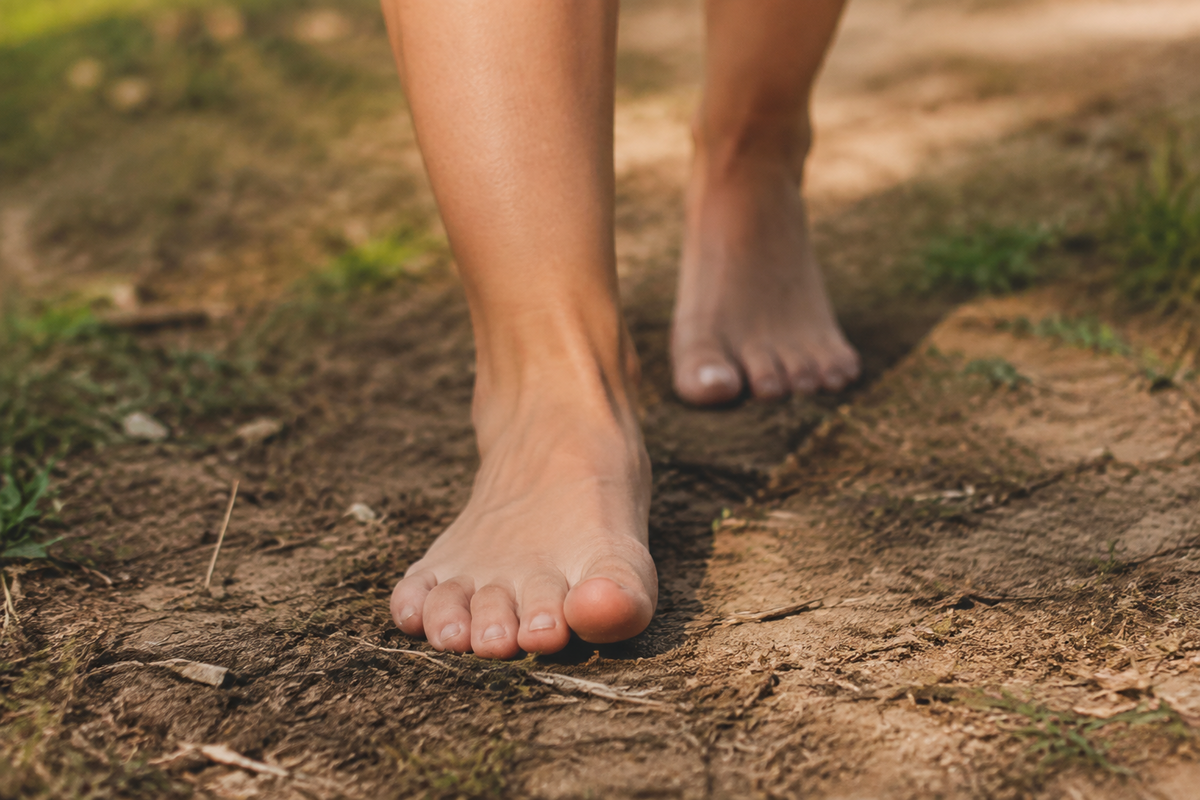
Have you ever stopped to think about just how incredible the human foot really is?
Twenty-six bones. Thirty-three joints. Layers of muscles, fascia, tendons, ligaments, nerves and sensory receptors—all working together every time we take a step.
But what makes the human foot truly fascinating is that it is uniquely designed for one thing that separates us from our primate relatives: walking upright on two feet.
Our ability to stand, walk, run and efficiently move through the world depends on a foot that can constantly transition between two seemingly opposite roles.
It must be flexible enough to absorb impact and then, within milliseconds, become rigid enough to propel us forward.
Understanding this duality is one of the keys to understanding healthy feet—and movement longevity.
The Foot Is a Spring
Every step begins with impact.
As our foot contacts the ground, forces travel through the body. Rather than simply resisting those forces, a healthy foot is designed to absorb them.
The arches of the foot deform slightly under load, while the connective tissues and fascia store elastic energy.
Think of it like loading a spring.
That stored energy can then be returned as we transition toward push-off, helping make human walking remarkably efficient.
This is why I don't think of the arch as a static structure that simply needs to be “supported.”
The arch is dynamic.
It needs to load.
It needs to adapt.
And it needs to recoil.
Our Arches Help Make Us Human
The human foot has three primary arches: the medial longitudinal arch, lateral longitudinal arch and transverse arch.
Together, these structures help the foot manage load, maintain stability and transfer energy as we move.
Interestingly, the architecture of the human foot continues developing throughout childhood, with the arches becoming increasingly defined as children grow and develop their walking and movement skills.
This is one reason I am so passionate about allowing children to experience varied movement, sensory input and opportunities to develop strong feet.
The foot isn't simply something we stand on.
It is something we develop through movement.
Every Step Is a Moment of Single-Leg Balance
Walking is essentially a repeated series of controlled falls from one leg to the other.
For a brief moment during every stride, your entire body is supported by one foot.
That means efficient walking requires something we often underestimate:
single-leg stability.
The better we can organize ourselves over one foot, the more efficiently we can move forward.
And this isn't just about muscular strength.
The nervous system needs accurate sensory information from the foot to understand where the body is relative to the ground.
This is where sensation becomes such an important part of movement.
Before the body can efficiently respond to the ground, it first needs to feel the ground.
From Mobile Adapter to Rigid Lever
After absorbing impact, the foot has another important job.
It must become rigid.
As we move toward the end of our stride, the foot transforms from an adaptable structure into a stable lever that allows us to push the body forward.
The big toe and first ray play an especially important role in this process.
Muscles including the peroneus longus and tibialis anterior help stabilize the first ray and support the mechanics required for efficient propulsion.
When this system is disrupted—whether through altered big-toe mechanics, bunions, weakness or instability through the midfoot—the foot may have difficulty creating the rigid lever needed for efficient push-off.
The body will still find a way forward.
It always does.
But compensation often comes with a cost.
Your Heel Is an Energy-Transfer System
Even the shape of the human heel reflects our evolution toward upright walking.
The calcaneus, or heel bone, provides an important attachment point for the Achilles tendon.
As we walk and run, the Achilles tendon stores and releases elastic energy, contributing to the spring-like efficiency of human movement.
This is another reminder that the body isn't designed as a collection of isolated parts.
The foot, Achilles tendon, calf, fascia and the rest of the kinetic chain work together as an integrated system for managing and transferring energy.
Foot Health Is About More Than Strength
When people think about healthy feet, they often immediately think about strengthening.
And strength absolutely matters.
But healthy movement requires more than strong muscles.
It requires the ability to:
Sense. Load. Adapt. Stabilize. Recoil.
This is why my approach to foot health always combines strength with sensory stimulation.
The thousands of sensory receptors in the feet continuously provide information to the nervous system about pressure, texture, vibration and our relationship with the ground.
At Naboso, this is the foundation of what we do.
By increasing sensory stimulation through the feet, our goal is to provide the nervous system with richer information from which it can organize movement.
Because movement doesn't begin with muscle.
Movement begins with information.
Try This: Build Your Foot-to-Hip Connection
One simple exercise I frequently use is a heel raise with a small ball positioned between the heels.
Gently squeeze the ball as you lift your heels from the ground.
Rather than simply trying to get as high as possible, focus on maintaining pressure through the big toe and creating a controlled, stable rise.
This helps reinforce the relationship between the big toe, first ray, arch and muscles that support efficient push-off.
Perform the movement slowly and intentionally.
Remember: quality of movement matters more than quantity.
Movement Longevity Starts from the Ground Up
Our feet evolved to do something extraordinary.
They sense the ground beneath us.
They absorb tremendous forces.
They store and release energy.
They balance our entire body on one leg.
And then they become rigid enough to propel us into our next step.
All within fractions of a second.
The more we understand the brilliance of the human foot, the more we realize that foot health isn't simply about eliminating pain.
It's about preserving our ability to interact with the world.
To walk.
To run.
To explore.
To remain independent.
And ultimately, to keep moving throughout our lifetime.
Because movement longevity starts from the ground up.


Leave a comment
This site is protected by hCaptcha and the hCaptcha Privacy Policy and Terms of Service apply.