

Every runner has asked some version of the same question:
"How do I avoid getting injured?"
For years, the conversation has centered around shoes, stretching, mileage, and whether you should heel strike or forefoot strike. While each of these factors plays a role, they miss what I believe is the most important piece of the puzzle:
How your nervous system responds to impact.
As a functional podiatrist and human movement specialist, I don't simply look at where pain occurs—I look at why the body failed to absorb and control force in the first place. Whether it's plantar fasciitis, Achilles tendinopathy, shin splints, runner's knee, or hip pain, many running injuries share a common denominator:
A delayed or inefficient loading response.
Running Is a Sensory Event
Every time your foot strikes the ground, your body experiences forces that are approximately three to four times your body weight.
That force isn't inherently dangerous.
In fact, our bodies were designed to manage it.
The problem occurs when the nervous system doesn't receive or process sensory information quickly enough to organize the body for landing.
Your feet are filled with thousands of mechanoreceptors that continuously provide information about pressure, vibration, texture, and movement. These receptors allow your brain to predict, stabilize, and prepare for every step.
One receptor deserves particular attention: the Pacinian corpuscle.
This receptor is highly sensitive to vibration and rapid changes in pressure—exactly the type of information generated during running. When stimulated efficiently, it helps trigger the body's rapid stabilization response.
When that sensory input is reduced—often by highly cushioned footwear or years of limited barefoot exposure—the response can become delayed.
Milliseconds matter.
A slight delay in neuromuscular activation means greater stress on muscles, tendons, fascia, and joints over thousands of repetitive steps.
Injury Prevention Is About Reflexive Stability
When most runners think about stability, they think about balance exercises or strengthening their core.
I think about reflexive stability.
Reflexive stability is your body's automatic ability to organize itself before conscious movement even occurs.
It begins with the foot.
One of my favorite exercises is the Short Foot Exercise, which activates the intrinsic muscles of the foot—particularly the abductor hallucis.
Why does this matter?
Because activating these muscles helps stabilize the arch, create a more efficient subtalar joint, and improve the connection between the foot, hip, and core.
The goal isn't simply to create a stronger foot.
It's to create a foot that communicates more effectively with the rest of the body.
When your foot becomes a better sensory organ, your entire movement system becomes more efficient.
Go Barefoot Before You Put Your Shoes On
One of the simplest strategies I recommend is something I call:
Barefoot Before Shod.
Before every run, spend just five minutes barefoot stimulating your nervous system.
Rather than immediately putting on your running shoes, allow your feet to reconnect with the ground first.
My preferred movement preparation includes:
-
Single-leg Short Foot holds
-
Single-leg Romanian deadlifts
-
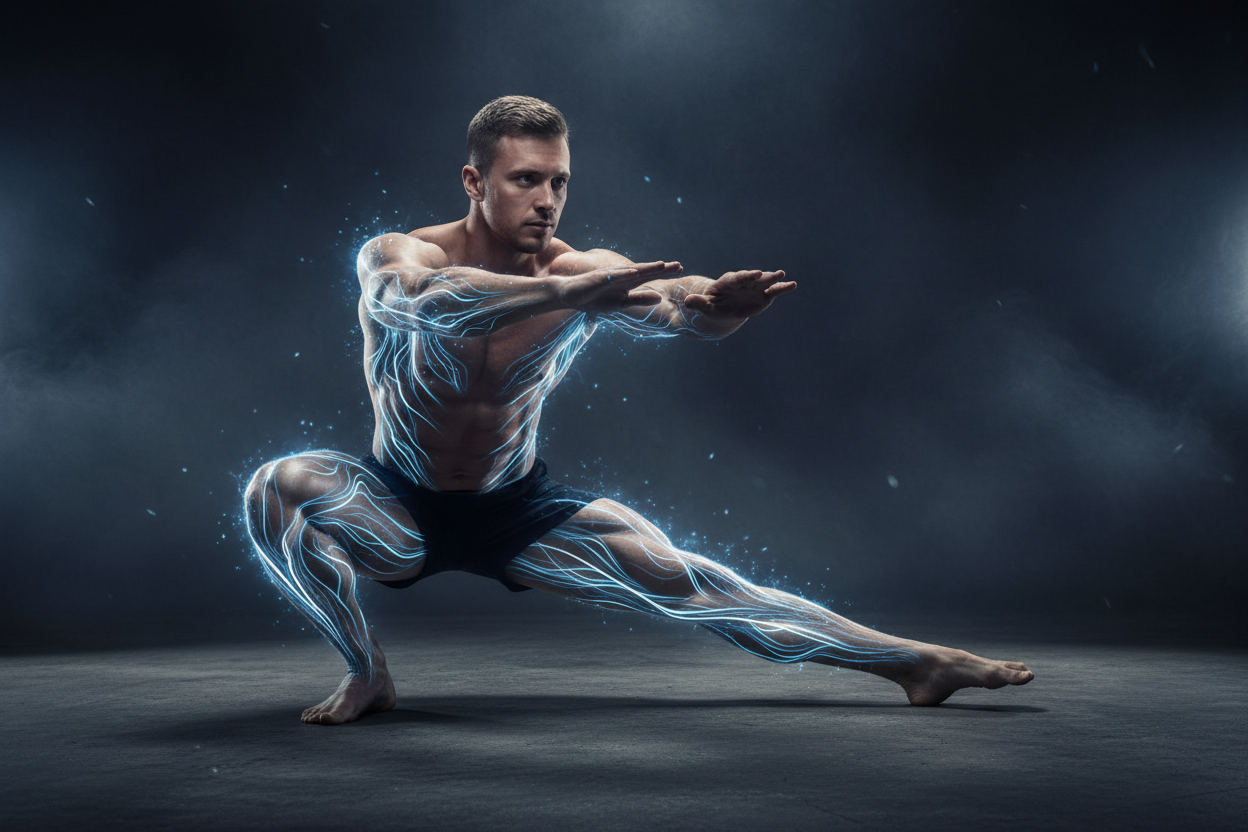
Single-leg squats
-
Floor taps
-
Rotational reaching movements
These aren't designed to fatigue your muscles.
They're designed to wake up your nervous system.
Think of them as calibrating your body's internal GPS before every run.
Stop Chasing Foot Strike
One of the biggest debates in running is whether runners should heel strike or forefoot strike.
I think we're asking the wrong question.
What matters far more is how you land.
Specifically, I focus on reducing the amount of ankle dorsiflexion present at the moment of impact.
A softer, more controlled landing allows your muscles to absorb force more efficiently while reducing the stress transmitted through the lower extremity.
Running mechanics should be evaluated as a whole-body strategy—not simply where your foot first contacts the ground.
Foam Rolling Isn't the Finish Line
Many runners spend time foam rolling before a run.
That's a great start—but it's only half the equation.
Foam rolling improves tissue hydration, mobility, and fascial glide.
However, if you don't follow that mobility work with activation exercises, your nervous system hasn't learned how to control the new range of motion you've created.
I always recommend pairing soft tissue work with movement.
Release first.
Activate second.
Integrate third.
Train Barefoot Beyond Your Warm-Up
A five-minute barefoot warm-up is incredibly valuable.
But to truly improve tissue capacity and neuromuscular control, I recommend adding dedicated barefoot training throughout the week.
Aim for approximately 30 minutes, three times per week.
This isn't about running barefoot.
It's about building:
-
Better intrinsic foot strength
-
Greater eccentric control
-
Improved balance
-
Faster sensory processing
-
More efficient loading mechanics
These adaptations don't just help reduce injury—they often improve running economy and performance as well.
Think Beyond the Foot
One of the biggest misconceptions about running injuries is that they're foot problems.
In reality, the foot is often where symptoms appear—not where dysfunction begins.
Every foot strike influences the ankle, knee, hip, pelvis, core, and even the way your brain predicts movement.
The body functions as one integrated kinetic chain.
That's why preventing injury isn't about buying a different shoe or stretching one tight muscle.
It's about improving how your entire system senses, responds to, and controls force.
The Future of Running Is Sensory
As runners, we often focus on getting stronger, faster, or logging more miles.
I believe the future of injury prevention begins somewhere else.
It begins with becoming more aware.
More aware of the ground.
More aware of your feet.
More aware of how your nervous system prepares your body for every landing.
When you improve sensory input, you improve movement output.
And when your body can better organize impact, every step becomes more efficient, more resilient, and ultimately more enjoyable.
Because running injury-free isn't just about stronger muscles.
It's about a smarter nervous system.


Leave a comment
This site is protected by hCaptcha and the hCaptcha Privacy Policy and Terms of Service apply.