

Movement longevity starts with your feet.
We often blame aging, weak muscles, or arthritis for why movement becomes more difficult over time. While those certainly play a role, one of the biggest determinants of how efficiently we move is something most people never think about—how their feet interact with the ground.
The foot isn't simply a structure designed to support body weight. It is a dynamic sensory organ, a spring, a shock absorber, and one of the body's most sophisticated energy management systems.
When your feet function well, every step becomes more efficient.
When they don't, your body pays the price.
Walking Is an Energy Problem
One of the concepts I teach most often is that walking is fundamentally about energetics.
Every time your foot strikes the ground, you create a ground reaction force. That force isn't just pressure—it's mechanical energy that travels through your entire body.
Your job is not simply to absorb that energy.
Your job is to capture it, store it, and return it.
Think of your body like a spring.
When the spring compresses, potential energy is stored.
When the spring recoils, that energy is released.
The more efficiently your body performs this process, the less muscular effort is required to keep moving.
This is why efficient walkers and runners often appear effortless. They aren't necessarily producing more energy—they're wasting less of it.
Movement longevity depends on minimizing these energy leaks over thousands of steps every day.
Humans Were Built for Efficient Locomotion
One of the defining characteristics of human evolution is our plantigrade foot.
Unlike many animals that primarily move on their toes, humans walk with both the heel and forefoot contacting the ground.
This unique structure allows us to:
-
Absorb impact through the heel
-
Store elastic energy through the arches
-
Transfer force through the Achilles tendon
-
Create powerful forward propulsion
Our feet evolved specifically for endurance walking.
Everything about their architecture supports efficient locomotion.
Before You Move, Set Your Base
One of the simplest—but most powerful—concepts I teach is something I call setting the base.
Before you think about squatting, walking, lifting, or running, establish a stable foundation.
This begins by:
-
Spreading the toes
-
Keeping the digits long and relaxed
-
Creating an active foot tripod
-
Allowing a slight external rotation through the hips
The foot tripod consists of three primary points of contact:
-
Heel
-
First metatarsal head
-
Fifth metatarsal head
These three points create the foundation from which your entire kinetic chain operates.
Without this stable base, everything above it must compensate.
Your Arches Are More Than Just Support
Most conversations about arches focus on whether someone has "high arches" or "flat feet."
I believe that's the wrong conversation.
Your arches are dynamic structures designed to manage energy.
The medial longitudinal arch, supported primarily by the posterior tibialis, helps control load while storing elastic energy.
The lateral longitudinal arch, supported largely by the peroneus longus, provides stability and balances forces across the outside of the foot.
Healthy arches don't remain rigid.
They gently compress under load before recoiling to return energy back into the body.
Think of them as biological springs.
Without this controlled compression, movement becomes significantly less efficient.
Why Your Foot Must Become Rigid
Although mobility is essential, there is one phase of walking where your foot must become remarkably stiff.
As you prepare to push off the ground, your flexible foot rapidly transforms into a rigid lever.
This transition is what allows stored energy to propel you forward.
One of the primary mechanisms responsible for this transformation is the Windlass Mechanism.
As your toes extend during push-off, the plantar fascia tightens, elevating the arch and locking the foot into a stable position.
At the same time, another often-overlooked system—the Tie-Bar Mechanism—helps stabilize the forefoot by controlling how the metatarsals spread under load.
Together, these mechanisms allow your foot to withstand enormous forces while minimizing energy loss.
Without them, every step becomes more expensive.
Strong Feet Are Different Than Gripping Feet
One of the biggest mistakes I see in rehabilitation is teaching people to grip with their toes.
Gripping creates tension.
Functional feet create stability.
This is why I rarely recommend towel scrunches.
Instead, I focus on restoring the function of the intrinsic foot muscles through exercises like the Short Foot Exercise.
The goal is to shorten the foot by lifting the arch—not curling the toes.
Healthy feet maintain:
-
Long toes
-
Straight toes
-
Wide toes
-
Active arches
When the intrinsic muscles weaken, we often begin seeing:
-
Hammer toes
-
Bunions
-
Metatarsalgia
-
Reduced balance
-
Less efficient walking
Each of these creates what I refer to as energy leaks—places where force is lost instead of transferred.
Sometimes Alignment Comes Before Strength
Not every foot can simply be strengthened.
If someone has significant ligament laxity, structural collapse, or longstanding toe contractures, restoring alignment may need to come first.
This is where tools become incredibly valuable.
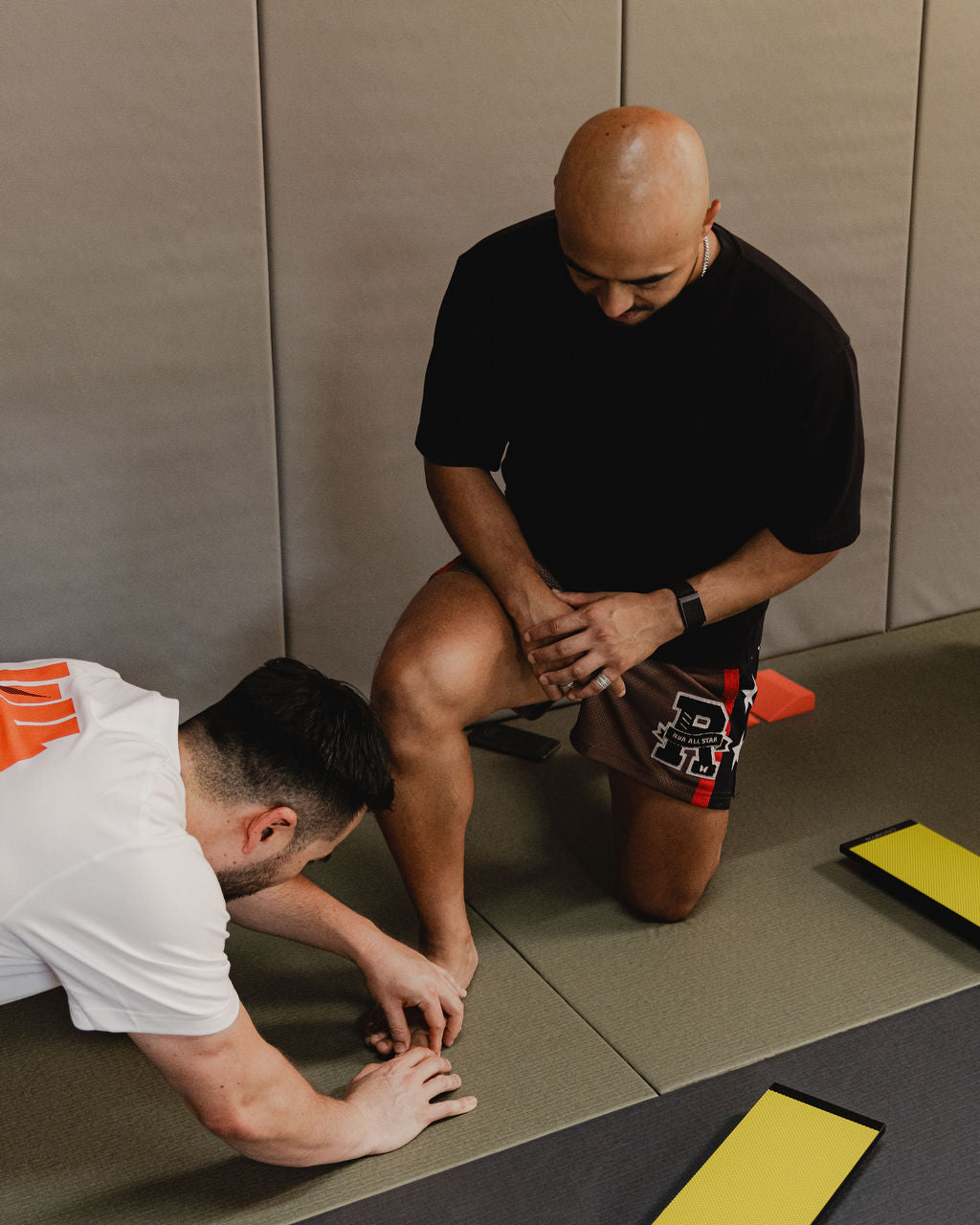
Toe spacers can help restore natural toe position while improving activation of the intrinsic muscles.
Foot wedges can improve foot posture in individuals who struggle to maintain tripod stability because of ligamentous laxity or chronic collapse.
These tools aren't replacing muscle function.
They're helping create the environment where the nervous system can relearn optimal movement.
Your Feet Connect to Your Entire Body
One of the reasons I became fascinated by fascia is because the foot doesn't function in isolation.
The foot forms the foundation of several major fascial continuities throughout the body.
The Deep Front Line links the foot with the pelvic floor, diaphragm, deep core, and neck.
The Spiral Line helps coordinate rotational movement throughout the body.
This is why improving foot posture often changes:
-
Hip stability
-
Pelvic control
-
Core activation
-
Balance
-
Walking efficiency
The feet are not simply supporting the body.
They're organizing it.
Movement Longevity Begins at Ground Level
One of the greatest myths in healthcare is that foot pain is simply something we should expect as we age.
I don't believe that.
I believe healthy feet are trainable.
They can become stronger.
More adaptable.
More sensory.
More efficient.
The earlier we begin caring for our feet, the greater our ability to continue hiking, traveling, exercising, playing with grandchildren, and living independently for decades to come.
Because movement longevity isn't determined by how old you are.
It's determined by how efficiently you move.
And every efficient step begins with your feet.


Leave a comment
This site is protected by hCaptcha and the hCaptcha Privacy Policy and Terms of Service apply.